

Liposomal vs. S-Acetyl Glutathione: Which Form Is Better?
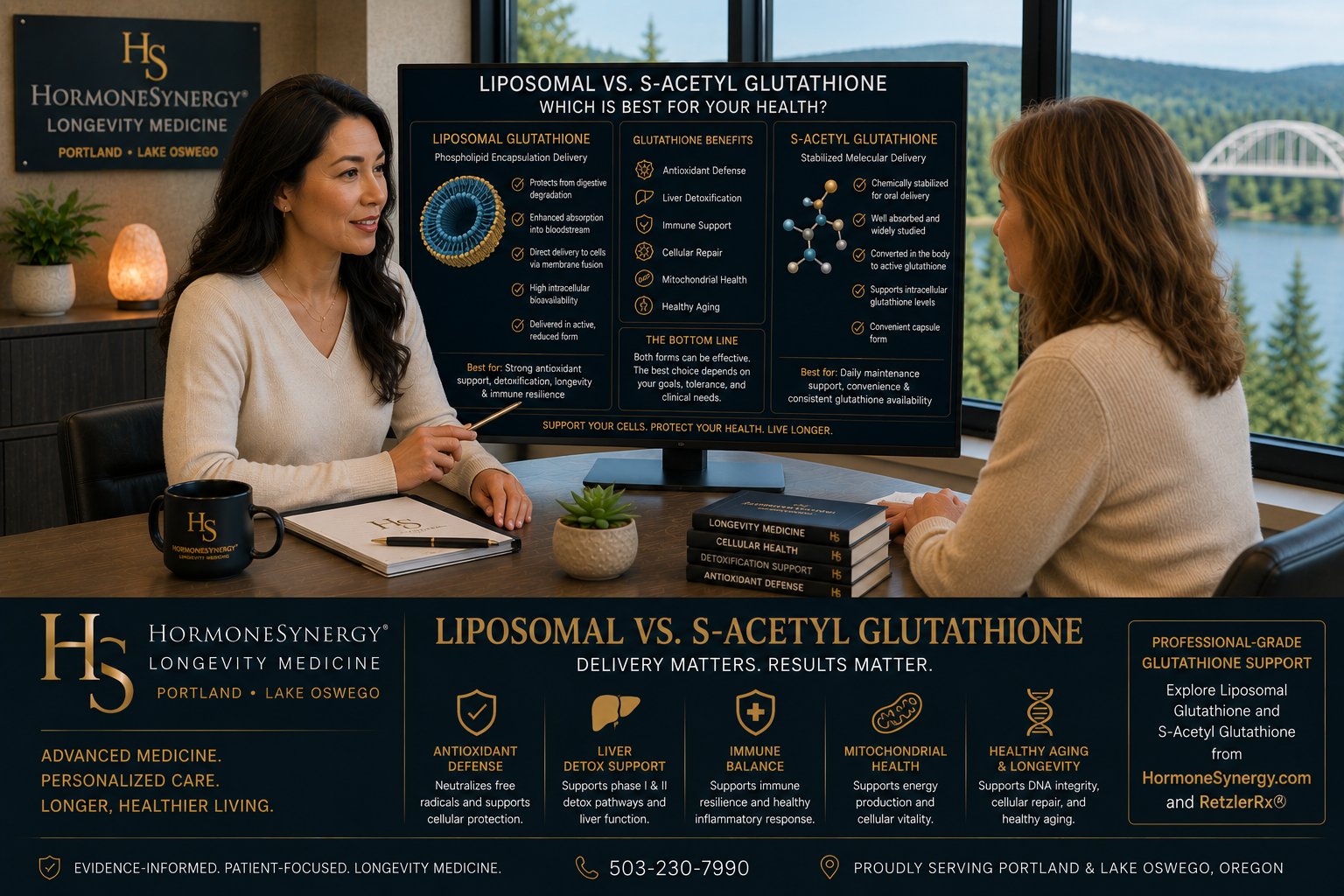
AI Overview: Liposomal and S-acetyl glutathione are both designed to improve oral delivery, but they use different strategies. Liposomal products encapsulate glutathione in phospholipids, while S-acetyl glutathione chemically protects the molecule until it is converted into glutathione. Small human studies support the biological plausibility of both approaches, but there are no robust head-to-head clinical trials proving that one produces better health outcomes than the other. Product quality, dose, tolerance, convenience and the reason for supplementation remain important.
Glutathione is one of the body’s central antioxidant systems. It helps regulate cellular redox balance, participates in the metabolism of certain drugs and environmental compounds, and supports normal immune and mitochondrial function.
Its biological importance has also made it an easy target for exaggerated marketing.
Consumers encounter reduced glutathione, liposomal glutathione, S-acetyl glutathione, NAC, glycine, sublingual products, intravenous preparations and vaguely defined “detox” formulas. Each may be promoted as the most absorbable or clinically powerful option.
One of the most common questions is:
Is liposomal glutathione better than S-acetyl glutathione?
Both forms have a reasonable delivery rationale. Both have some supportive evidence. Neither has enough direct comparative clinical research to be declared universally superior.
The distinction matters because three different questions are often blended together:
- Can the formulation survive digestion or improve delivery?
- Can it increase glutathione measurements in blood or tissues?
- Does it improve a symptom, disease outcome or meaningful measure of health?
Evidence for one question does not automatically answer the others.
What Glutathione Does in the Body
Glutathione is a tripeptide made from glutamate, cysteine and glycine. It exists primarily in reduced and oxidized forms that participate in a continuously regulated redox system.
Glutathione contributes to:
- Cellular antioxidant defense
- Redox signaling
- Normal metabolism of certain drugs and environmental compounds
- Recycling of other antioxidants
- Immune-cell function
- Mitochondrial protection
- Protein and enzyme regulation
- Cellular resilience during oxidative stress
Glutathione is not a magical cleanse. Its production and recycling depend on protein intake, amino-acid availability, selenium, magnesium, B vitamins, metabolic health, liver function and the body’s overall oxidative burden.
Supplementation may be useful in selected circumstances, but it remains one part of a much larger biological system.
Is Ordinary Oral Glutathione Absorbed?
The older view was that standard oral glutathione was largely broken down in the digestive tract and therefore had little value. Human research has made that conclusion less certain.
An earlier short-term randomized trial did not find meaningful changes in several oxidative-stress markers after oral glutathione. A later six-month randomized trial found that daily oral glutathione increased glutathione stores in several blood compartments and tissues.
These findings do not establish that every oral product is equally effective. They show that the claim “ordinary oral glutathione cannot work at all” is too absolute.
They also illustrate an important distinction: increasing a laboratory measure of glutathione is not automatically proof that supplementation prevents disease, improves longevity or produces a noticeable clinical benefit.
What Is Liposomal Glutathione?
Liposomal glutathione places reduced glutathione within or alongside microscopic phospholipid structures. The proposed purpose is to help protect glutathione during digestion and facilitate delivery across biological membranes.
This mechanism is plausible, but the word liposomal does not guarantee that a product contains stable, well-formed liposomes or that it has been tested in humans.
What Human Research Shows
A small four-week pilot study of liposomal glutathione reported increases in glutathione measurements in blood and immune cells at daily doses of 500 and 1,000 milligrams. Changes in selected oxidative-stress and immune markers were also reported.
This provides preliminary human evidence that the tested formulation reached biologically relevant compartments. However, the study was small, lacked a placebo control and evaluated biomarkers rather than long-term clinical outcomes.
It does not prove that every liposomal product performs similarly or that liposomal glutathione treats disease, improves symptoms or extends life.
Potential Practical Advantages
- Direct delivery of reduced glutathione
- Phospholipid-based formulation
- Some supportive human biomarker research
- Availability in liquid, gel, packet and softgel forms
Potential Limitations
- Substantial variation in manufacturing quality
- Stability can be affected by heat, storage and formulation
- Some liquids have an unpleasant taste or odor
- Higher cost does not guarantee better delivery
- Human clinical-outcome evidence remains limited
What Is S-Acetyl Glutathione?
S-acetyl glutathione is glutathione with an acetyl group attached to its sulfur atom. The modification is intended to protect the molecule from premature oxidation or breakdown. After absorption, cellular enzymes can remove the acetyl group and make glutathione available.
This is a chemical-stabilization strategy rather than a lipid-delivery strategy.
What Human Research Shows
A small randomized, single-dose crossover study compared S-acetyl glutathione with standard reduced glutathione in 18 healthy adults.
The study reported greater plasma glutathione exposure after S-acetyl glutathione, but results were highly variable. Glutathione measurements within red blood cells were slightly higher after the standard glutathione formulation. The study used a single high dose and did not evaluate symptoms, disease outcomes or long-term use.
This supports the conclusion that S-acetyl glutathione can be absorbed and rapidly converted. It does not prove that S-acetyl glutathione is clinically superior to standard or liposomal glutathione.
Potential Practical Advantages
- Chemically stabilized glutathione
- Convenient capsule-based dosing
- No liposomal taste or texture
- Generally simple to store and travel with
- Preliminary human pharmacokinetic evidence
Potential Limitations
- Much of the evidence remains mechanistic or preclinical
- Human research is limited and based on small studies
- Absorption evidence does not establish clinical superiority
- Results may depend on the specific ingredient and formulation
Liposomal vs. S-Acetyl Glutathione Comparison
| Comparison | Liposomal Glutathione | S-Acetyl Glutathione |
|---|---|---|
| Delivery strategy | Phospholipid encapsulation intended to protect and transport reduced glutathione | Chemical stabilization intended to protect glutathione until deacetylation |
| Common format | Liquid, gel, packet or softgel | Capsule, tablet or powder |
| Human absorption evidence | Small pilot research reports increased glutathione stores and related biomarkers | Small single-dose study reports increased plasma exposure compared with standard glutathione |
| Clinical-outcome evidence | Limited; biomarker findings do not establish broad health or disease benefits | Limited; pharmacokinetic findings do not establish broad health or disease benefits |
| Direct head-to-head evidence | No robust human trial has established whether liposomal or S-acetyl glutathione produces better clinical outcomes. | |
| Potential practical strength | Direct reduced-glutathione delivery with phospholipid protection | Stable, convenient capsule-based delivery |
| Potential practical limitation | Taste, storage, cost and variable liposome quality | Less extensive human research and reliance on conversion after absorption |
| Reasonable fit | Someone who prefers a phospholipid delivery system and tolerates the format | Someone who prioritizes capsule convenience, stability and consistent use |
What the chart does not show: It does not establish a universal winner. Neither formulation has strong enough comparative clinical evidence to justify saying that it is best for every person or health goal.
Absorption Claims vs. Clinical Evidence
Supplement marketing frequently moves too quickly from mechanism to outcome.
A product may demonstrate:
- Better stability in a laboratory
- Higher blood levels after a dose
- Increased glutathione in selected cells
- Changes in an oxidative-stress biomarker
Those findings can be meaningful, but they do not automatically prove that the product:
- Improves energy or cognition
- Prevents cardiovascular or neurodegenerative disease
- “Detoxifies” the body in a clinically meaningful way
- Treats chronic illness
- Slows biological aging
- Improves longevity
Those larger claims require controlled clinical trials measuring patient-important outcomes. That evidence is not currently available for a broad declaration that liposomal or S-acetyl glutathione is clinically superior.
Evidence in one sentence: Both delivery systems are biologically plausible and supported by limited human biomarker or pharmacokinetic data, but neither has been proven superior for meaningful clinical outcomes.
How to Evaluate a Liposomal Product
The term liposomal is not a complete quality standard. A useful product review should consider:
- Identity and amount of glutathione per serving
- Phospholipid source and formulation
- Manufacturing controls
- Stability and storage requirements
- Testing for contaminants and microbial quality
- Whether the finished formulation has supporting data
- Packaging that protects the product from heat, oxygen and light
A poorly constructed product does not become effective simply because “liposomal” appears on the label.
How to Evaluate an S-Acetyl Product
For S-acetyl glutathione, useful considerations include:
- Ingredient identity and sourcing
- Amount of S-acetyl glutathione per serving
- Purity and stability testing
- Independent quality controls
- Capsule excipients and tolerance
- Whether the claimed benefits remain proportional to the available evidence
The presence of an acetyl group provides a reasonable delivery rationale. It does not permit unlimited claims about detoxification, disease treatment or longevity.
Which Form Might Be More Practical?
Liposomal Glutathione May Be Reasonable When:
- A phospholipid delivery system is preferred
- The patient tolerates liquid, gel or softgel formulations
- The selected product has credible manufacturing and stability controls
- Cost and storage requirements are manageable
- The clinician has experience with the particular formulation
S-Acetyl Glutathione May Be Reasonable When:
- Capsule convenience improves adherence
- Liposomal taste or texture is poorly tolerated
- A stable travel-friendly format is important
- The ingredient and finished product meet appropriate quality standards
- The patient responds well within an individualized plan
Convenience is not trivial. A theoretically sophisticated product provides little value if it is unpleasant, difficult to store or used inconsistently.
Do You Need Direct Glutathione or Precursors?
Another consideration is whether to take glutathione directly or support the body’s own production.
Glutathione synthesis depends on:
- Cysteine
- Glycine
- Glutamate
- Adequate dietary protein
- Selenium
- Magnesium
- B vitamins
N-acetylcysteine, or NAC, provides cysteine, which can be rate-limiting for glutathione production. Glycine may also become limiting in some people, particularly with aging or inadequate protein intake.
Precursor support and direct glutathione supplementation are not interchangeable in every circumstance. The response to NAC depends partly on the body’s capacity to synthesize glutathione, while direct formulations attempt to deliver glutathione or a protected derivative.
Some people may need neither. Others may use a precursor, direct glutathione or a combination selected according to diet, health history, medications, laboratory findings and clinical goals.
The HormoneSynergy® and RetzlerRx® Perspective
At HormoneSynergy®, we consider both liposomal and S-acetyl glutathione legitimate formulation strategies. We do not believe the existing evidence supports declaring either form universally superior.
Product selection should consider:
- The reason for supplementation
- Ingredient and manufacturing quality
- Dose and formulation
- Tolerance and convenience
- Cost and expected duration of use
- Dietary protein and precursor availability
- Relevant laboratory or clinical findings
- Whether the product is producing a meaningful benefit
RetzlerRx® offers Patented S-Acetyl Glutathione as a stable capsule-based option. We also offer S-Acetyl Glutathione Ultra with NAC when combined direct and precursor support is appropriate.
HormoneSynergy® also curates selected liposomal products for patients who prefer that delivery format. Availability does not replace individualized judgment, and no single formulation is automatically appropriate for everyone.
Bottom Line
Liposomal glutathione uses phospholipid delivery. S-acetyl glutathione uses chemical stabilization. Both are intended to improve on the limitations associated with ordinary oral glutathione.
Small human studies suggest that liposomal glutathione can increase glutathione stores and that S-acetyl glutathione can increase plasma glutathione exposure after a single dose. These findings support biological delivery, but they do not establish that one form produces better clinical outcomes.
A reasonable decision should therefore be based on formulation quality, dose, tolerance, convenience, clinical purpose and individual response rather than a marketing claim that one form always wins.
Related Reading
- What Is the Best Glutathione Supplement?
- What Is the Best Form of Glutathione?
- Creatine, Creatinine and Kidney Function
Selected Research
- Randomized controlled trial of oral glutathione supplementation on body stores of glutathione
- Oral supplementation with liposomal glutathione and body glutathione stores
- Single-dose crossover study of S-acetyl glutathione in healthy volunteers
- Review of dietary nutrients and strategies that may support glutathione status
Frequently Asked Questions
Is liposomal glutathione better than S-acetyl glutathione?
Current evidence does not establish a universal winner. Liposomal glutathione has small human studies showing increased glutathione stores, while S-acetyl glutathione has limited pharmacokinetic evidence showing absorption and conversion. Robust direct comparisons of clinical outcomes are lacking.
Which form is absorbed better?
Both forms are designed to improve delivery, but they have not been adequately compared against each other in robust human trials. Results from separate studies cannot reliably establish which form is better absorbed because the doses, products, methods and participants differ.
Does better absorption mean better health outcomes?
Not necessarily. Greater absorption or a change in a glutathione biomarker can support biological plausibility, but meaningful claims about symptoms, disease prevention or longevity require clinical-outcome research.
Is standard oral glutathione useless?
No. Human studies have produced mixed results, but longer-term research suggests that ordinary oral glutathione can increase glutathione stores in some blood and tissue compartments. Product, dose, duration and individual response may all matter.
Can NAC replace glutathione?
NAC supplies cysteine for glutathione synthesis. It may be useful when precursor availability is limiting, but its effect depends on the body’s ability to synthesize glutathione. Some people may use precursor support, direct glutathione or both.
How should I choose a glutathione supplement?
Consider the clinical reason for using it, ingredient identity, dose, manufacturing quality, stability, storage, tolerance, cost and whether the product is producing a meaningful benefit. The delivery label alone is not enough.
Educational Disclaimer
These statements have not been evaluated by the Food and Drug Administration. This information is educational and is not intended to diagnose, treat, cure or prevent disease. Consult an appropriate healthcare professional before using a new supplement, particularly during pregnancy or nursing, when taking medication, or when managing a medical condition.
Editorial Transparency
HormoneSynergy® and RetzlerRx® sell some of the products discussed in this article. The evidence does not establish that liposomal or S-acetyl glutathione is universally superior, and product recommendations should reflect individual need, quality, tolerance and clinical context. This article was created with AI-assisted drafting support and reviewed and edited by the HormoneSynergy® team for accuracy, clarity and alignment with its clinical perspective.
This article is part of the HormoneSynergy® Longevity Medicine education series covering preventive cardiology, metabolic health, hormone optimization, body composition, and advanced diagnostics for healthy aging.
Return to the Longevity Medicine Guide →