

What Is the Best Glutathione Supplement? A Buyer’s Guide to Formulation, Testing and Quality
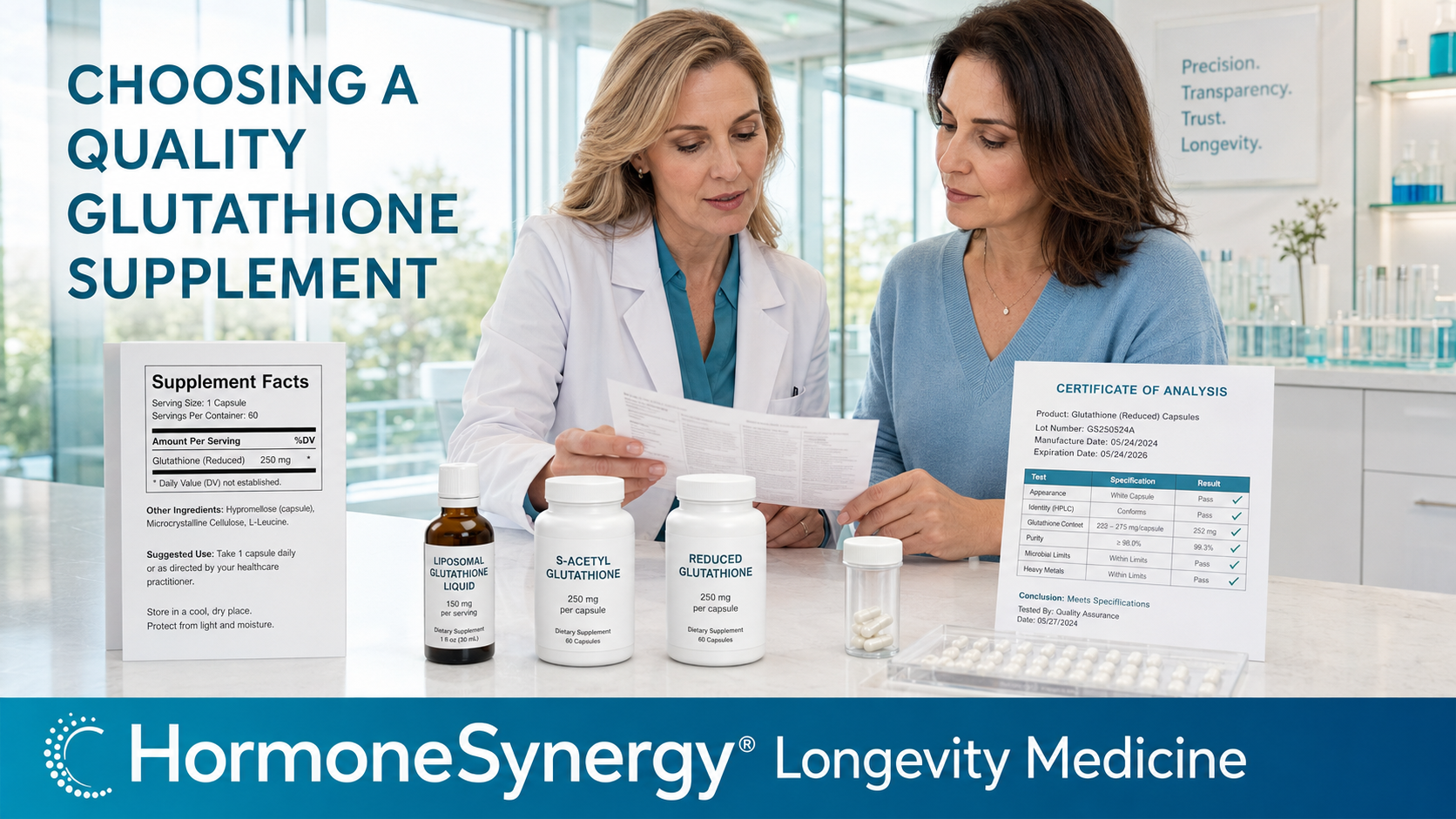
AI Overview: The best glutathione supplement cannot be identified by the word “liposomal,” “reduced” or “S-acetyl” alone. A quality product should disclose the amount of active glutathione, use a defensible formulation, remain stable through its expiration date, and be manufactured under appropriate current good manufacturing practices. Finished-product testing should verify identity, potency and relevant contaminants. Liposomal and S-acetyl formulations both have plausible delivery strategies, but neither is universally superior. Dosage, tolerance, storage, manufacturer transparency and the reason for supplementation all matter.
Shopping for glutathione should be straightforward. Instead, consumers encounter a crowded market of products claiming superior absorption, direct cellular delivery, pharmaceutical-grade quality and dramatic detoxification benefits.
Those claims often sound more certain than the evidence allows.
A product may contain a legitimate form of glutathione and still be poorly formulated, inadequately tested, improperly stored or underdosed. Conversely, a simpler formulation may be useful when it is accurately labeled, consistently manufactured and supported by appropriate quality controls.
This guide focuses on the questions that matter when buying a glutathione supplement:
- What form and amount does it contain?
- Is the delivery claim supported by formulation data?
- Will the product remain stable through its expiration date?
- Was the finished product tested?
- Who manufactured it, and under what quality system?
- Does the dosage make sense for the intended use?
- Are the marketing claims proportional to the evidence?
For a detailed scientific comparison of the two most heavily marketed delivery forms, read Liposomal vs. S-Acetyl Glutathione: Which Form Is Better?
For a broader explanation of oral, reduced, liposomal, S-acetyl, sublingual, intravenous and precursor approaches, read What Is the Best Form of Glutathione?
Start With the Actual Ingredient
Before evaluating delivery technology, identify what the product actually contains.
Reduced Glutathione, GSH or L-Glutathione
These terms are often used for the biologically relevant reduced form of glutathione. The letter “L” refers to the amino-acid configuration. It does not mean that the product is automatically cheap, ineffective or inferior.
Human research suggests that consistent oral reduced glutathione can increase glutathione stores in at least some blood and tissue compartments. The evidence is not strong enough to support every marketing claim, but it is also inaccurate to say that ordinary L-glutathione never works.
Liposomal Glutathione
Liposomal products combine glutathione with phospholipids intended to form small lipid structures that help protect and transport the ingredient.
The delivery concept is plausible, and small human studies support biological delivery from tested formulations. However, the word “liposomal” does not confirm:
- That stable liposomes were actually formed
- How much glutathione is encapsulated
- The particle size or consistency of the formulation
- Whether the liposomes remain stable through the expiration date
- That the finished product was studied in humans
S-Acetyl Glutathione
S-acetyl glutathione chemically protects the sulfur portion of the molecule with an acetyl group. After absorption, the group can be removed and glutathione made available.
This provides a reasonable stability and delivery strategy. Limited human pharmacokinetic evidence supports absorption and conversion, but it does not establish that S-acetyl glutathione is clinically superior to every reduced or liposomal product.
Glutathione Precursors
NAC provides cysteine, while glycine supplies another amino acid needed to synthesize glutathione. These ingredients support internal production rather than delivering glutathione directly.
Direct glutathione and precursor products should not be compared milligram for milligram as if they were interchangeable. They use different biological strategies.
The Glutathione Buyer-Quality Checklist
| Quality Question | Better Sign | Reason for Caution |
|---|---|---|
| Is the active form identified? | Reduced, liposomal or S-acetyl glutathione is clearly named | Only “glutathione complex” or “detox blend” is disclosed |
| Is the amount disclosed? | Milligrams of active glutathione per serving are stated | Glutathione is hidden within a proprietary blend |
| Was the finished product tested? | Identity, potency and relevant contaminants are evaluated on finished lots | Testing applies only to a raw-ingredient supplier document |
| Is stability addressed? | Storage directions, packaging and shelf life are supported by stability controls | No meaningful storage information for a sensitive liquid product |
| Who manufactured it? | The brand can identify the manufacturer and quality standards | The seller cannot explain where or how the product was produced |
| Are delivery claims verified? | Claims refer to the specific ingredient or finished formulation | Generic liposome science is used to prove an untested product |
| Are clinical claims restrained? | The product is described as supporting antioxidant or glutathione status | Claims to cure disease, eliminate toxins, reverse aging or guarantee results |
| Is the seller trustworthy? | Authorized supply chain, appropriate storage and traceable lot information | Unknown marketplace seller or unclear storage and product origin |
1. Formulation: The Delivery Word Is Only the Beginning
A formulation is more than its featured ingredient. It includes the active form, dose, excipients, delivery system, manufacturing process, packaging and storage conditions.
Questions for a Liposomal Product
- What phospholipid source is used?
- How much glutathione is present per serving?
- Is the amount measured before or after accounting for the entire lipid mixture?
- Does the manufacturer evaluate particle size or size distribution?
- Is encapsulation or association with the lipid system assessed?
- How is oxidation controlled?
- Does the product require refrigeration?
- What happens after opening?
Consumers may not receive every proprietary technical detail, but a serious manufacturer should be able to explain how it verifies that the product is more than glutathione mixed with lecithin.
Questions for an S-Acetyl Product
- Is the ingredient specifically identified as S-acetyl glutathione?
- Is it a branded or otherwise traceable ingredient?
- Is identity confirmed analytically?
- Is the amount of active ingredient disclosed?
- Are purity, potency and degradation controlled through shelf life?
Questions for Reduced Glutathione
- Is the ingredient identified as reduced glutathione or GSH?
- Is the source traceable?
- Does the product provide a meaningful disclosed amount?
- Is oxidation to GSSG controlled and evaluated?
- Does the packaging protect against moisture and air?
2. Stability: What Is in the Bottle at the End of Shelf Life?
A supplement can begin with the correct ingredient and still lose quality during manufacturing, shipping or storage.
Glutathione and phospholipids can be sensitive to:
- Heat
- Oxygen
- Moisture
- Light
- Changes in pH
- Repeated opening and contamination
- Extended storage after opening
Liposomal Stability
Liposomal liquids deserve particular attention because both the glutathione and lipid components can change over time. Liposomes may aggregate, leak their contents or undergo phospholipid oxidation if the formulation and packaging are inadequate.
Useful signs include:
- Clear storage directions
- A defined shelf life after opening
- Protective packaging
- Lot and expiration information
- Manufacturer stability testing
Do not assume that every liposomal product requires refrigeration. Follow the directions supported by that specific formulation. Refrigeration also cannot restore a product that was unstable during shipping or manufacturing.
Capsule Stability
S-acetyl and reduced-glutathione capsules may be easier to store, but they still require protection from heat, humidity, oxidation and manufacturing variability. Chemical stability is an advantage only when it is maintained in the finished product.
3. Testing: “Third-Party Tested” Is Not a Complete Answer
Third-party testing can add meaningful assurance, but the phrase is often used without explaining what was tested, when it was tested or which product lot was evaluated.
A useful testing program may assess:
- Identity: Is the ingredient actually the claimed form of glutathione?
- Potency: Does the finished product contain the labeled amount?
- Purity: Are unwanted related compounds or degradation products controlled?
- Microbiology: Does the product meet appropriate microbial limits?
- Heavy metals: Are arsenic, cadmium, lead and mercury within appropriate limits?
- Residual solvents: Are manufacturing solvents controlled when relevant?
- Stability: Does potency remain acceptable through the expiration date?
- Delivery characteristics: For liposomal products, are relevant physical characteristics evaluated?
Raw Ingredient Testing vs. Finished-Product Testing
A raw-material certificate of analysis can help confirm the ingredient entering the factory. It does not prove that the finished capsules or liquid contain the correct amount, remained uncontaminated or survived manufacturing intact.
Finished-product testing provides stronger information about what is actually in the bottle being sold.
Lot-Specific Certificates of Analysis
A certificate of analysis is most useful when it corresponds to the lot number on the product. A generic certificate posted for years or a supplier document unrelated to the finished lot provides less assurance.
Certification Seals
Independent programs such as NSF and USP may verify label claims, manufacturing controls and selected contaminants. These certifications can be valuable, but participation is voluntary and not every high-quality practitioner product carries a consumer-facing seal.
The absence of a seal does not prove poor quality. It makes manufacturer transparency and documented testing more important.
4. Dosage: More Is Not Automatically Better
There is no universally established glutathione dose for general wellness, detoxification or longevity.
Human studies have used differing forms, doses and treatment periods. Research involving ordinary oral or liposomal glutathione has commonly evaluated amounts ranging from several hundred milligrams to approximately 1,000 milligrams daily. Those study doses should not be interpreted as a universal recommendation.
A reasonable dosage assessment should consider:
- The exact form of glutathione
- The amount of active ingredient per serving
- The reason for supplementation
- Body size and nutritional status
- Concurrent NAC, glycine or other precursors
- Medical conditions and medications
- Tolerance and duration of use
- Whether there is a meaningful response to monitor
Do Not Compare Unlike Milligrams
Five hundred milligrams of a liposomal mixture may not mean 500 milligrams of glutathione. The Supplement Facts panel should state the active amount clearly.
Likewise, 500 milligrams of NAC is not equivalent to 500 milligrams of glutathione. NAC supplies a precursor and depends on the body’s synthesis pathway.
Be Cautious With “Effective at a Lower Dose”
A formulation may produce higher blood exposure in a pharmacokinetic study, but that does not automatically establish that a lower dose produces the same clinical result. Dose-equivalence claims require direct comparative studies measuring relevant outcomes.
5. Manufacturer Quality
In the United States, dietary-supplement manufacturers are required to follow current good manufacturing practices under 21 CFR Part 111. These requirements address identity, purity, strength, composition and limits on contamination.
Compliance is foundational. It does not prove that a product is clinically effective.
What “FDA Registered” Does Not Mean
Dietary supplements are not approved by the FDA before marketing in the way prescription drugs are. Facility registration does not mean:
- The FDA approved the supplement
- The FDA confirmed its effectiveness
- The FDA tested every finished lot
- The FDA endorses the manufacturer
“Made in an FDA-registered facility” should not be presented as an FDA seal of approval.
What Stronger Manufacturers Do
- Qualify raw-material suppliers
- Verify ingredient identity
- Establish written product specifications
- Test or appropriately verify finished lots
- Investigate out-of-specification results
- Maintain batch records and traceability
- Conduct stability programs
- Control packaging, labeling and storage
- Maintain systems for complaints and adverse-event reporting
The brand on the bottle and the company manufacturing the product may be different. A responsible brand should know who manufactures its products and how that manufacturer is qualified.
6. Claims That Should Make You Pause
Be cautious when a glutathione product claims to:
- Remove all toxins from the body
- Reverse aging
- Prevent cancer or neurodegenerative disease
- Repair every cell
- Produce pharmaceutical-level absorption without product-specific evidence
- Deliver glutathione directly to whichever tissue “needs it most”
- Work because its liposomes automatically merge with target cells
- Be clinically superior based only on laboratory or animal research
- Guarantee visible results within days
Glutathione biology is legitimate. That does not make every glutathione claim legitimate.
Is Liposomal Glutathione Better Than S-Acetyl Glutathione?
Current evidence does not justify answering “yes” for everyone.
Liposomal glutathione uses a phospholipid delivery strategy. S-acetyl glutathione uses chemical stabilization followed by conversion into glutathione. Both are biologically plausible, and both have limited supportive human evidence.
What has not been established is that liposomal glutathione consistently provides:
- Greater cellular uptake than S-acetyl glutathione in humans
- More direct delivery to target tissues
- Faster or more clinically meaningful effects
- Better symptom, disease or longevity outcomes
No robust human head-to-head trial has established a universal winner. The quality of the specific finished product may matter more than the delivery category printed on the front label.
Read the full evidence comparison in Liposomal vs. S-Acetyl Glutathione: Which Form Is Better?
How HormoneSynergy® Evaluates Supplements
HormoneSynergy® and RetzlerRx® prioritize manufacturers and products that can demonstrate appropriate quality controls rather than relying on label design or marketplace popularity.
Our evaluation considers:
- Manufacturer experience and transparency
- Current good manufacturing practices
- Raw-material identity and sourcing
- Finished-product specifications
- Potency and contaminant testing
- Stability and packaging
- Formulation rationale
- Evidence proportional to marketing claims
- Clinical usefulness and patient tolerance
We have personally toured leading private-label supplement manufacturers to better understand their sourcing, testing, production and quality-control systems. That experience reinforced an important point: two bottles with similar Supplement Facts panels may not represent the same manufacturing quality.
We also recommend purchasing through the manufacturer, an authorized practitioner portal or a traceable professional source. Unknown marketplace sellers can introduce questions about authenticity, storage, expiration dates and supply-chain handling.
HormoneSynergy® Glutathione Options
RetzlerRx® offers Patented S-Acetyl Glutathione as a stable capsule-based option.
S-Acetyl Glutathione Ultra with NAC combines direct S-acetyl glutathione with precursor support when that formulation is appropriate.
HormoneSynergy® also curates selected liposomal glutathione products for people who prefer a phospholipid delivery system.
These options are not interchangeable in every circumstance, and product availability does not mean every person needs glutathione supplementation.
Bottom Line
The best glutathione supplement is not determined by the boldest absorption claim.
Look for:
- A clearly identified form
- A disclosed active dose
- A defensible formulation
- Finished-product identity and potency controls
- Relevant contaminant testing
- Stability through the expiration date
- A qualified and transparent manufacturer
- Storage appropriate to the formulation
- Claims that remain proportional to human evidence
Liposomal and S-acetyl glutathione can both be reasonable. Standard reduced glutathione also has human evidence and should not be dismissed solely because it is less expensive. The specific product, manufacturer and clinical purpose matter more than declaring one marketing category the universal winner.
Related Reading
- Liposomal vs. S-Acetyl Glutathione: Which Form Is Better?
- What Is the Best Form of Glutathione? Oral, Liposomal, S-Acetyl, IV and Precursors
- Are Dietary Supplements Really Unregulated?
Selected Resources
- FDA dietary-supplement current good manufacturing practice guidance
- FDA questions and answers about dietary supplements
- NSF supplement and vitamin certification overview
- Randomized trial of oral glutathione and body glutathione stores
- Pilot study of liposomal glutathione supplementation
Frequently Asked Questions
What should I look for in a glutathione supplement?
Look for a clearly identified form, disclosed active dose, appropriate manufacturing controls, finished-product testing, stability information, traceable lot and expiration details, and claims proportional to human evidence.
Is liposomal glutathione always better?
No. Liposomal delivery is plausible and supported by limited human research, but the word “liposomal” does not verify encapsulation, stability, absorption or clinical superiority. The quality of the specific formulation matters.
Is S-acetyl glutathione better than reduced glutathione?
S-acetyl glutathione offers chemical stability and limited human pharmacokinetic evidence. It has not been proven universally more effective than standard reduced glutathione.
Does inexpensive L-glutathione work?
Price alone does not determine effectiveness. L-glutathione usually refers to the biologically relevant amino-acid configuration, often in reduced form. Human research suggests consistent oral use can increase glutathione stores, although results and product quality vary.
What does third-party tested mean?
The phrase is meaningful only when the company explains what was tested. Useful testing may include identity, potency, microbes, heavy metals, relevant impurities and stability. Finished-lot testing provides more assurance than a generic raw-ingredient certificate.
Does FDA registration mean a supplement is approved?
No. Dietary supplements are not approved by the FDA before marketing in the same way as prescription drugs. Facility registration does not mean that the FDA tested, approved or endorsed the finished product.
How much glutathione should I take?
There is no universal dose for general wellness or longevity. The appropriate amount depends on the form, reason for use, concurrent precursors, medical history and clinician guidance. Study doses should not automatically be treated as personal recommendations.
Educational Disclaimer
These statements have not been evaluated by the Food and Drug Administration. This information is educational and is not intended to diagnose, treat, cure or prevent disease. Consult an appropriate healthcare professional before using a new supplement, particularly during pregnancy or nursing, when taking medication, or when managing a medical condition.
Editorial Transparency
HormoneSynergy® and RetzlerRx® sell some products discussed in this guide. Product selection should reflect formulation quality, testing, tolerance and individual need rather than product availability or marketing category. This article was created with AI-assisted drafting support and reviewed and edited by the HormoneSynergy® team for accuracy, clarity and alignment with its clinical and quality perspective.
This article is part of the HormoneSynergy® Longevity Medicine education series covering preventive cardiology, metabolic health, hormone optimization, body composition, and advanced diagnostics for healthy aging.
Return to the Longevity Medicine Guide →